
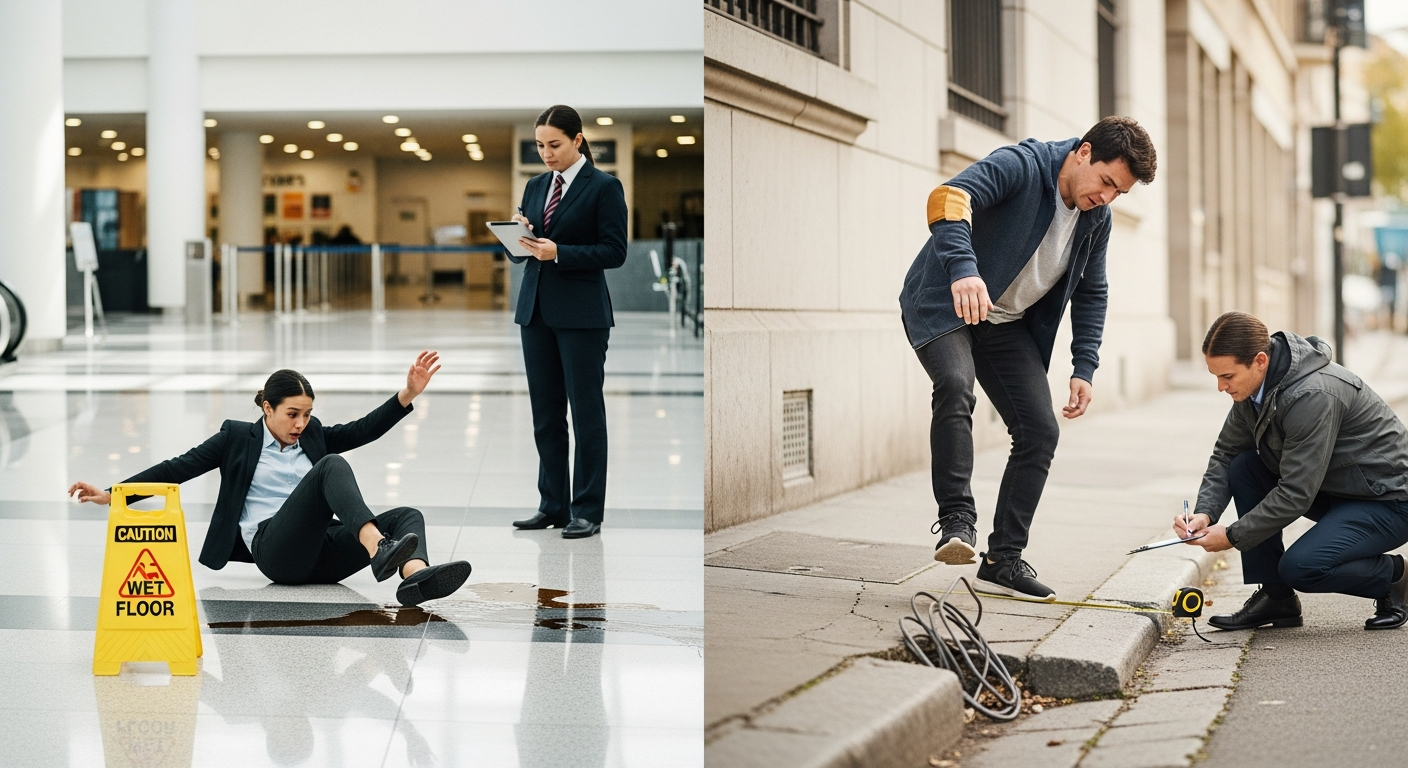
Personal injury claims often involve complex terminology, and one of the most common points of confusion is the distinction between a slip and fall vs trip and fall. While both incidents can lead to severe physical trauma and mounting medical bills, the legal proof required to win your case depends entirely on the physics of how you hit the ground.
At The Roth Firm, we believe that understanding these differences is the first step toward a successful recovery. Our team of legal professionals combines decades of experience with a peer-like, supportive approach to ensure our clients feel grounded throughout the litigation process. If you have been injured on someone else’s property, contact our law firm today for legal help throughout Georgia and Tennessee.
Slip and Fall vs Trip and Fall: Key Takeaways
- Slip-and-fall accidents are caused by a lack of friction between your foot and the floor, while trip-and-fall accidents result from an obstruction in your path.
- Liability in slip cases often centers on temporary hazards, such as spills, whereas in trip cases it frequently involves structural defects, such as uneven pavement.
- Successful claims require documenting the direction of the fall, as slips typically send victims backward and trips send them forward.
Legal Definitions of Slip vs. Trip Accidents
The legal world distinguishes these two based on the physical mechanics of the accident. A slip-and-fall occurs when there is a loss of traction between the pedestrian’s foot and the walking surface. This lack of friction causes the foot to slide out, often resulting in the victim falling backward or to the side. This motion frequently leads to injuries in the lower back, hips, or the back of the head.
By contrast, a trip-and-fall happens when a person’s foot hits an object or an unexpected change in the elevation of the walking path. This sudden interruption of forward momentum typically sends the victim’s center of gravity forward. Because the body is propelled ahead, trip victims often suffer injuries to their hands, wrists, elbows, and face as they naturally reach out to break their fall.
Typical Causes: Wet Floors vs. Uneven Surfaces
The environment of your accident often dictates which type of claim you have. Slip-and-fall accidents are almost always linked to “slick” hazards. Common examples include spilled liquids in grocery aisles, freshly mopped floors without “Caution” signs, or ice in a parking lot. According to the National Safety Council (NSC), falls and slips resulted in a total cost of $54,499 in medical and indemnity costs in 2022 to 2023.
Trip-and-fall accidents are usually the result of a physical obstruction. Typical causes include cracked or heaving sidewalks, loose floor mats, or bunched carpeting. These hazards are often more “permanent” than a spill, which can affect how a premises liability lawyer establishes who knew about the danger. For instance, a broken sidewalk is a structural defect that a property owner likely should have noticed over weeks or months.
How Liability is Established in Each Case
To win a settlement, you must prove the property owner was negligent. In both Georgia and Tennessee, this requires showing that the owner had “actual or constructive knowledge” of the hazard. In slip-and-fall cases, we often have to prove that a spill was on the floor long enough for a reasonable employee to have discovered and cleaned it.
In trip-and-fall cases, liability is often easier to establish because the hazards are frequently structural. A missing handrail is a condition that likely existed for a significant period of time. Data from the Bureau of Labor Statistics (BLS) shows that falls, slips, and trips accounted for 865 work-related fatalities in 2022, highlighting the severe consequences when owners ignore their legal duty to maintain safe premises.
Evidence Required for Success
Because the physics of the falls differ, the evidence must be tailored to the specific type of accident. For a slip-and-fall, we prioritize surveillance footage to determine how long a liquid was on the floor. Cleaning logs is also vital, as they reveal if the business followed its own safety protocols. We also look for evidence that a “Caution” sign was missing or improperly placed.
For a trip-and-fall, the focus shifts to physical measurements. We use rulers and levelers to document exactly how high a sidewalk was raised or how deep a pothole was. Building code violations are often the “smoking gun” in trip cases, as many municipalities have specific safety standards for stair height. Photographs of the obstruction taken from multiple angles at the time of the fall remain the most persuasive evidence for any jury.
Average Settlements in Fall Cases
While every case is unique, national averages provide a helpful baseline for what victims might expect. Most slip-and-fall settlements range from $10,000 to $50,000. However, if the injury involves a Traumatic Brain Injury (TBI) or spinal damage, settlements can reach into the hundreds of thousands or even millions. In April 2025, a Las Vegas jury awarded $15 million for a slip-on-spill case, though such high figures are reserved for the most catastrophic outcomes.
The Centers for Disease Control and Prevention (CDC) reports that falls are the leading cause of nonfatal injuries and injury-related deaths for older adults. Factors that influence your settlement include the total cost of medical bills and lost wages. Insurance companies also look at “pain and suffering,” which is often calculated using a multiplier based on your total medical expenses.
Get Legal Help from a Premises Liability Lawyer
You do not have to face the aftermath of a fall alone. Whether you slipped on a spill or tripped over a hazard, the legal team at The Roth Firm is here to provide the compassionate advocacy you need to get back on your feet.
Contact The Roth Firm today for a free consultation to discuss your case and your path to recovery. We help victims throughout Tennessee and Georgia. Call (404) 640-5761.
Premises Liability Lawyer: Bottom Line
Understanding the mechanical difference between a slip-and-fall and a trip-and-fall is essential for building a strong legal case. While a slip involves a lack of traction and a backward fall, a trip consists of an obstruction and a forward fall. Documenting these details through photos and medical records is the best way to ensure you receive the compensation you deserve for your injuries.
Slip-and-fall vs. trip-and-fall: FAQ.
If you have been involved in a fall, you likely have several frequently asked questions about slip and fall vs trip and fall claims.
What is the statute of limitations for a fall case in Georgia? In Georgia, you generally have two years from the date of the accident to file a lawsuit, although claims against government entities often have much shorter deadlines of six months to one year.
Can I still recover a settlement if I was partially at fault? Yes. Georgia and Tennessee both use modified comparative negligence, meaning you can recover damages as long as you are less than 50% responsible for the fall.
Do I need to see a doctor if I don’t feel pain immediately? Yes. Internal injuries and soft-tissue damage often take 24 to 48 hours to manifest. Seeing a doctor immediately creates a medical record that links the injury to the fall.
What if the property owner fixed the hazard right after I fell? While you generally cannot use a “subsequent remedial measure” as direct proof of negligence in court, it can be helpful during settlement negotiations or to establish who controlled the property.
What are the most common injuries in trip accidents? Because victims fall forward, wrist fractures, facial lacerations, and dental injuries are the most common, as people naturally reach out to break their fall.
About Our Firm
The Roth Firm is a premier personal injury practice dedicated to serving victims in Georgia and Tennessee. We specialize in complex premises liability cases, bringing a mix of legal expertise and authentic empathy to every client we represent. To learn more about our team and our history of success, please visit our About Us page