
If you or a loved one was seriously hurt in a golf cart accident in Peachtree City, you may be able to recover compensation for medical bills, lost income, and long-term harm. Knowing how these claims work from the start can help protect that recovery.
Golf carts are part of daily life here. Roughly 11,000 registered carts share more than 100 miles of multi-use paths with pedestrians and cyclists, and they meet full-size vehicles at road crossings. Carts have no enclosed cabin or airbags, so even a low-speed crash can cause serious injuries. The claim that follows often involves city ordinances, multiple at-fault parties, and insurance policies that may not cover carts at all.
This article explains why cart crashes in Peachtree City so often cause injuries, which state and city rules apply, who can be held liable, how Georgia’s shared-fault rule affects your recovery, and what to do after a crash. Contact us at (404) 999-4705.
Key Takeaways
- In Peachtree City police data from 2021 through mid-2026, about 41% of reported golf cart crashes caused an injury, compared with about 8% of passenger vehicle crashes.
- Liability can fall on another driver, a cart owner, a property owner, or a manufacturer, so a Peachtree City car accident lawyer often has to sort through several insurance policies.
- Georgia reduces your recovery by your share of fault and bars it entirely if you are found at least as responsible as the other side.
- Punitive damages are a narrow exception, available only where Georgia’s civil code expressly authorizes them.
Why Golf Cart Crashes Cause So Many Injuries in Peachtree City
The path network links neighborhoods, schools, and shopping centers, so carts share space with cyclists and pedestrians and meet full-size vehicles at road crossings.
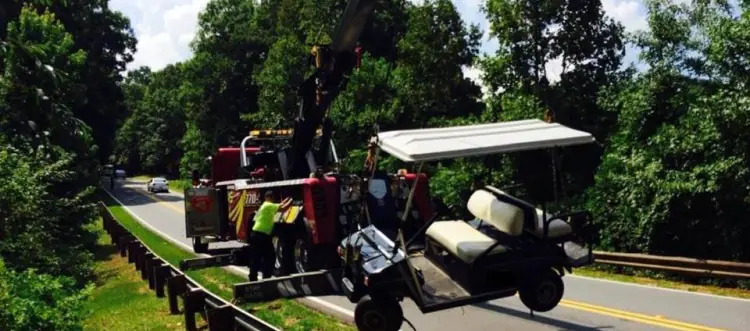
A tow truck lifts a damaged golf cart off a tree-lined road after an accident. Photo: Laurel Clarke / PTC People.
Cart crashes make up a small share of the city’s traffic accidents, but they are far more likely to hurt someone. The Citizen reported that about 41% of reported cart crashes from 2021 through the first half of 2026 caused injuries, versus about 8% of passenger vehicle crashes. In a cart crash, riders are easily thrown or strike the pavement. Peachtree City does not require seat belts or child seats in carts. Its only occupant rule bars driving with a child in the driver’s lap.
Carts may not travel on Highway 54, Highway 74, Peachtree Parkway, or Crosstown Drive. They may cross these roads only at designated crossings, such as tunnels, bridges, and marked crosswalks, which is where carts and car traffic meet.
Georgia and Peachtree City Golf Cart Rules
Georgia law sorts small vehicles by speed, as summarized by the Georgia Department of Public Safety:
- Golf cart: built for use on a golf course and limited to low speeds.
- Personal transportation vehicle (PTV): a somewhat faster class of small vehicle that state law treats separately.
- Low-speed vehicle: faster still, built to federal safety standards, and subject to its own registration and road rules.
State law lets cities decide where carts may operate. Peachtree City’s rules for its multi-use paths include:
- Registration: carts used on the paths must be registered with the city.
- Who can drive: older teens may drive alone without a driver’s license. Younger children may drive only with a parent, grandparent, or legal guardian in the front seat, and the city sets a minimum age for each tier.
- Night driving: carts need working headlights and taillights after dark.
- Right of way: pedestrians always have the right of way on paths, and carts entering a road crossing must yield to traffic with the right of way.
When a driver breaks a safety rule and that violation causes a crash, Georgia law can treat the violation itself as strong evidence of negligence.
Who Can Be Held Liable for a Golf Cart Injury
A cart crash can involve more than one responsible party:
- Another driver: speeding, failing to yield, distraction, or impairment.
- A cart owner or parent: negligent entrustment, such as letting a child drive outside the city’s age rules.
- A rental company or dealership: poor maintenance, such as faulty brakes.
- A property owner, homeowners association, or local government: dangerous path conditions, such as broken pavement, which fall under premises liability. A claim against a city carries a written-notice deadline that is much shorter than the usual deadline to file a lawsuit.
- A manufacturer: a defective accelerator, brake, or rollover structure.
What Damages You Can Recover
Most recovery in a golf cart case covers real, documented losses: out-of-pocket medical costs, future treatment, lost wages, cart repair or replacement, and pain and suffering.
Punitive damages are the exception, not the rule. They are not available just because a driver was careless, or even grossly negligent. They can be awarded only where Georgia’s civil code expressly authorizes them, which requires clear proof of intentional or reckless misconduct, such as malice or a conscious disregard for others’ safety. State law also limits the amount in most cases, with different treatment for defective-product cases and for defendants who intended harm or were impaired.
How Shared Fault Affects Your Recovery
Georgia follows a modified comparative fault rule. Your award is reduced by your share of fault, and if you are found at least as responsible as the other side, you recover nothing. Insurers often try to shift blame onto cart riders, so document signage, skid marks, and the cart’s maintenance history early.
What to Do After a Golf Cart Accident
- Get a medical evaluation right away, even if your injuries seem minor.
- Photograph the crossing or path, the cart, skid marks, and signage.
- Avoid giving a recorded statement to an insurer before you speak with an attorney.
- Preserve the cart for a mechanical inspection, if possible.
Frequently Asked Questions
Do I need a police report?
In most cases, yes. A report records the scene while memories are fresh, and insurers rely on it heavily.
Will the other driver’s auto insurance cover my injuries?
Not always. Standard auto policies often exclude golf carts the policyholder owns unless a golf cart endorsement was added. Coverage may instead come from a golf cart policy or a homeowner’s policy, depending on the policy language.
How long do I have to file?
Georgia sets a firm deadline for filing an injury lawsuit, and claims against a city have a much shorter notice deadline. Speak with a lawyer as soon as you can.
Can I recover damages if I wasn’t wearing a seat belt?
Possibly. Peachtree City does not require seat belts in carts, but an insurer may still argue that not wearing one worsened your injuries.
Talk to The Roth Firm About Your Golf Cart Injury
If you were hurt in a golf cart accident in Peachtree City or Fayetteville, the fault and insurance questions are rarely simple. Learn more about our attorneys or contact us at (404) 999-4705 for a free case review.