
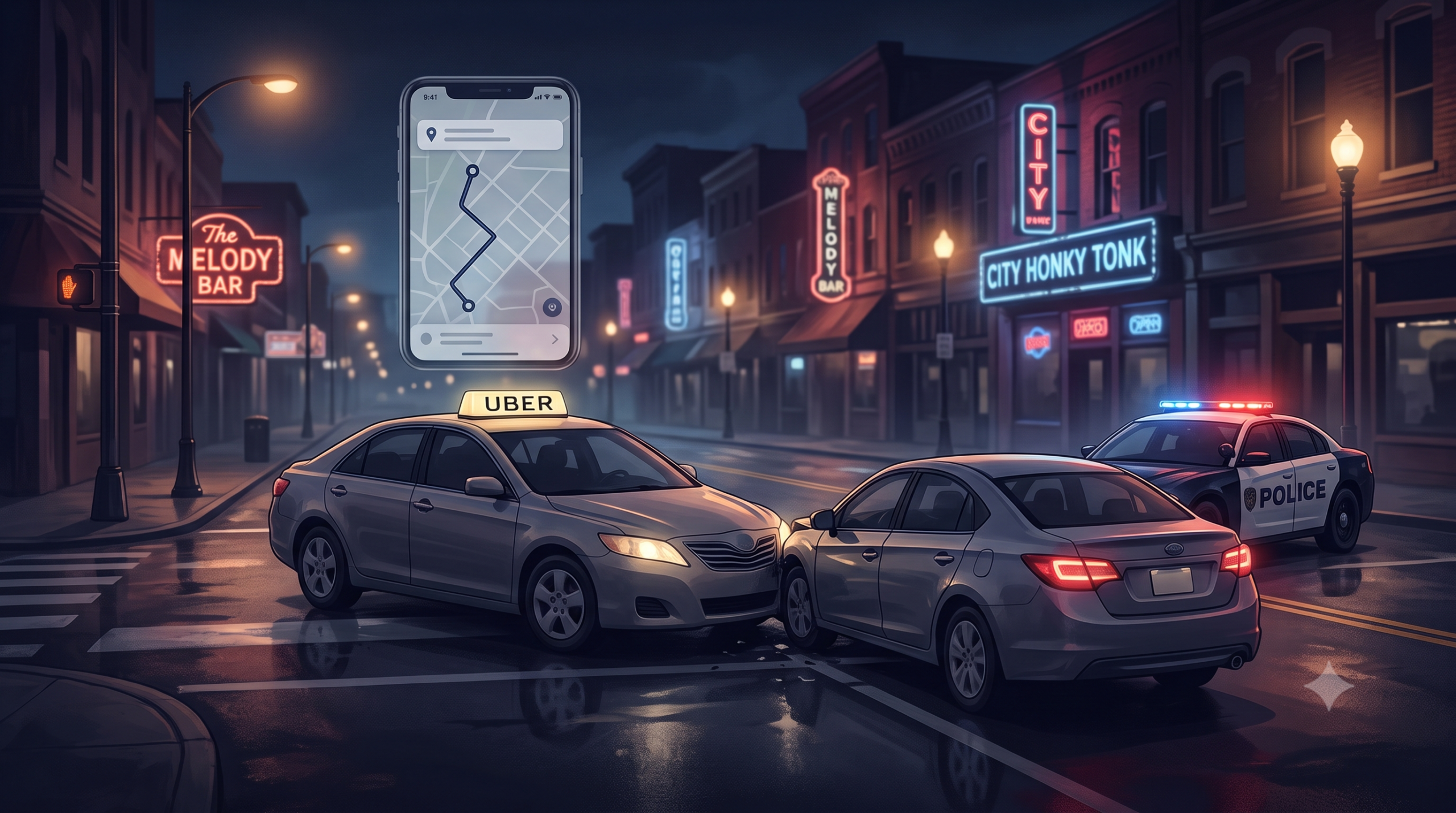
Nashville’s Lower Broadway corridor and the I-65/I-24 interchange are among Tennessee’s highest-density rideshare zones and among the most legally complex when crashes occur
You are now facing layered insurance disputes, competing liability claims, and corporate adjusters whose job is to minimize your recovery.
Nashville Lyft accident lawyers handle these exact claims.
What you do in the next 48 hours will either protect your case or compromise it.
When to Call 911 and What to Document at the Scene
Call 911 immediately even if the crash appears minor. A Metro Nashville Police report creates an official factual record no insurer can later rewrite. Before anyone leaves the scene, collect:
- The rideshare driver’s full name, license number, and vehicle plate
- Screenshots of your active trip in the Uber or Lyft app (pickup time, driver name, route)
- Photos of all vehicle damage, road conditions, skid marks, and traffic controls
- Contact information for every witness present
- The responding officer’s name and incident report number
Never agree to handle the situation informally without a police report. Insurers exploit every undocumented gap. Seek medical attention the same day, even for pain that seems minor. A same-day medical record establishes a direct causal link between the crash and your injuries. Gaps in treatment are the primary tool adjusters use to challenge the severity of your claim.
Essential Evidence: Receipts and Digital App Logs
Your trip receipt is timestamped proof of the driver’s app status at the exact moment of impact the single variable that controls which insurance policy governs your claim. Request it through the app immediately and save it to email. Under Tennessee’s Transportation Network Company Services Act (Tenn. Code Ann. § 55-26-101), coverage limits are tied directly to the driver’s logged status at the time of the crash.
Within 24 hours, back up the following to a single cloud folder:
- In-app trip receipt and confirmation email
- Screenshots of any in-app driver communication
- Bank or card statement showing the fare charge
- Surge pricing or route-change notifications
- GPS data if you tracked the route independently
Uber and Lyft retain this data internally but will not produce it voluntarily. Extracting it requires a formal preservation letter or discovery subpoena issued through counsel. The sooner the process begins, the lower the risk of critical logs being overwritten.
Know Which Insurance Period Applies to Your Crash
The most consequential fact in any Uber or Lyft injury claim is not who was driving, it is what the rideshare app was showing at the moment of impact. Tennessee law and platform policy both structure coverage around three distinct periods:
- Period 1 App Off: Only the driver’s personal auto policy applies. No Uber or Lyft coverage exists.
- Period 2 App On, Awaiting a Ride: Contingent coverage of $50,000 per person / $100,000 per accident / $25,000 property damage applies but only after the driver’s personal insurer first denies the claim.
- Period 3 Ride Accepted Through Drop-Off: Uber or Lyft’s primary $1,000,000 liability policy applies immediately, with no prior denial required.
That $950,000 gap between Period 2 and Period 3 is why insurers aggressively contest which period was active. In Nashville’s high-density pickup zones, where drivers routinely run multiple apps simultaneously, the classification dispute can become the central issue in your entire claim.
Understanding Tennessee’s Modified Comparative Fault Rule
Tennessee’s modified comparative fault system under Tenn. Code Ann. § 29-11-103 sets a strict threshold: if your share of fault reaches 50 percent, you recover nothing. At 49 percent fault, you recover, but your damages are reduced by that percentage. A $200,000 verdict with 30 percent fault attributed to you yields $140,000. The same verdict at 50 percent fault yields zero.
Rideshare defense teams exploit this deliberately. Standard tactics include arguing the passenger distracted the driver, failed to buckle up, or opened a door into traffic. Every percentage point of fault they successfully assign to you reduces your recovery. Locking in the factual record through documentation, witness statements, and preservation demands is how you control the fault narrative before the defense builds its own.
Dealing with Multiple Insurance Adjusters (Uber/Lyft)
After a Nashville rideshare crash, expect simultaneous outreach from the driver’s personal insurer, Uber or Lyft’s third-party claims administrator, and potentially the carrier for any other vehicle involved. Each of these adjusters represents their client’s financial exposure, not your recovery.
What to Say and Not Say to Any Adjuster
Do not give a recorded statement to any adjuster without an attorney present. Phrases that seem neutral, “I’m a little sore,” “the light might have been yellow,” or “I’m not sure who moved first,” become transcript evidence used to minimize your injuries or shift fault. Provide your name and contact information only. Tell the adjuster your attorney will follow up. Then make that call before anything else.
Frequently Asked Questions
Can I still recover compensation if I was partially at fault for the rideshare crash?
Yes, but only if your fault is less than 50 percent. Under Tennessee’s modified comparative fault rule (Tenn. Code Ann. § 29-11-103), your damages are reduced proportionally by your assigned fault percentage. At 49 percent fault on a $100,000 claim, you recover $51,000. At exactly 50 percent, you recover nothing. Uber and Lyft’s defense teams target this threshold directly, citing seatbelt non-use, passenger distraction, or door-opening. A clean, documented factual record built at the scene is your primary defense against that strategy.
How long do I have to file a rideshare injury claim in Tennessee?
One year in most cases under Tenn. Code Ann. § 28-3-104, extended to two years when criminal charges arise from the same incident. Rideshare claims compress that window further: app logs are overwritten, medical records must be compiled, and multi-insurer liability must be mapped before a demand can be sent. Retaining counsel early is the only way to protect evidence before it degrades.
Do Uber’s or Lyft’s $1 million policies automatically cover me as a passenger?
Only under Period 3 when the driver has accepted your specific request, and you are in the vehicle. If the driver was app-on but awaiting a ride (Period 2), coverage drops to $50,000 per person and applies only after the driver’s personal insurer has denied the claim. Your timestamped trip receipt is the document that establishes which period and which coverage tier controls your claim.
Consult a Nashville Rideshare Accident Attorney
Rideshare claims require managing app-status disputes, multi-insurer negotiations, Tennessee’s strict 50 percent fault bar, and a two-year statute of limitations under Tenn. Code Ann. § 28-3-104 that begins running from the crash date. Miss that window and your right to recovery is gone, regardless of how strong your case is.
The Nashville personal injury attorneys at The Roth Firm represent rideshare accident victims on a contingency-fee basis with no fees unless your case resolves. The firm’s rideshare and personal injury practice areas are built for multi-party, multi-insurer claims in Davidson County courts.
Contact The Roth Firm for a free consultation, and have our litigation team review your claim before the adjusters’ version of events becomes the controlling record.
Disclaimer: This content is for informational purposes only and does not constitute legal advice, nor an attorney-client relationship. Prior results do not guarantee a similar outcome.