
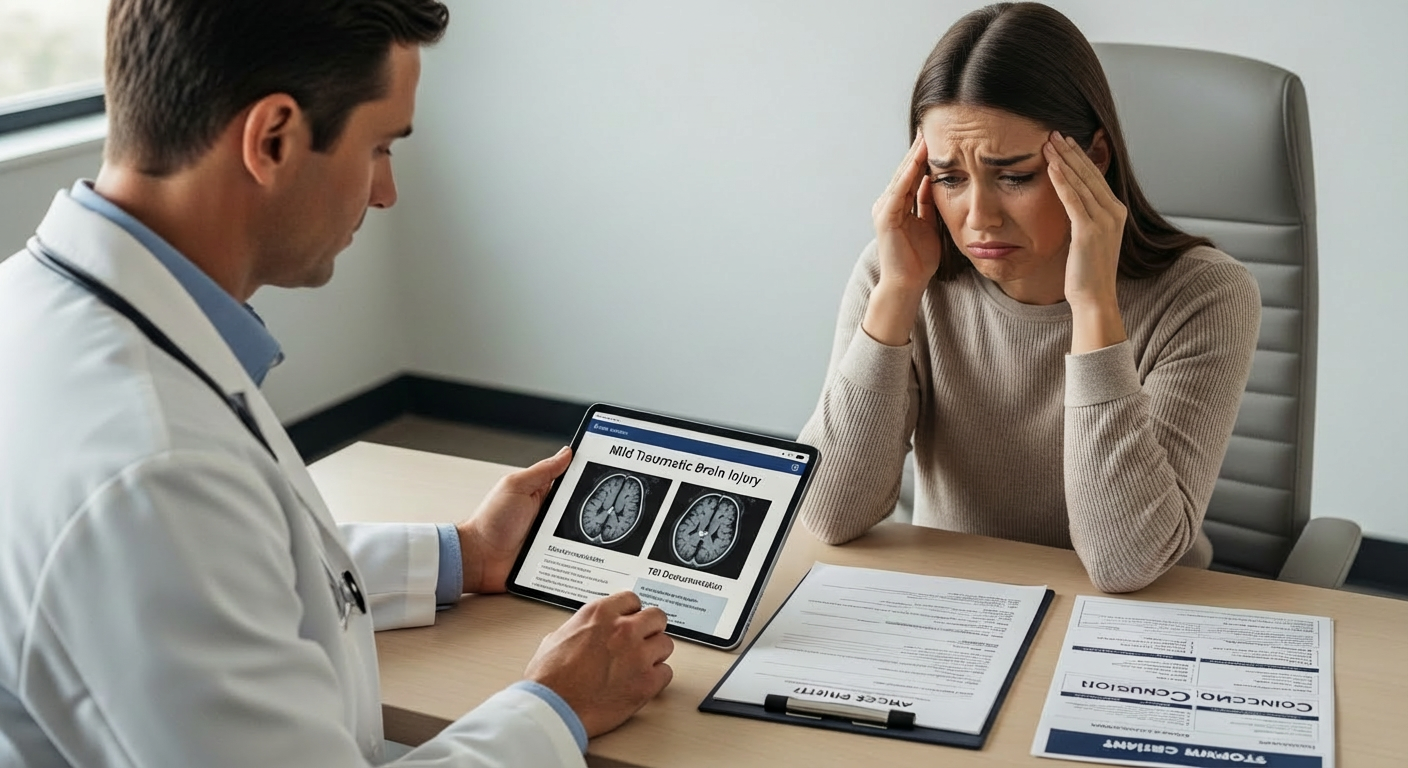
Imagine walking away from a car crash feeling lucky because you have no broken bones. A week later, you find that you cannot remember your grocery list or keep your temper in check. Many survivors hear the word mild and assume their injury isn’t serious.
At The Roth Firm, we know that a mild traumatic brain injury can turn your world upside down. We are here to help you clear the fog and secure the support you need to heal with confidence. Contact our law firm today for legal help in Tennessee or Georgia. Call (404) 640-5761.
Concussion After Car Accident: Key Takeaways
- Clinical labels do not define your journey: A diagnosis of mTBI is based on how long you were unconscious. It does not predict the emotional or physical challenges you may face during your long-term recovery.
- Objective evidence validates your experience: Specialized neuropsychological testing provides the necessary TBI medical documentation to prove cognitive deficits that standard hospital scans often miss.
- Proactive legal care protects your future: Connecting with an attorney early helps you build a treatment plan. This maximizes your brain injury settlement value and ensures your future medical needs are met.
Difference Between Mild and Severe TBIs
Medical professionals use the Glasgow Coma Scale (GCS) to categorize the severity of a brain injury immediately following an accident. This scale measures motor responses, verbal ability, and eye opening to assign a score. A severe TBI involves extensive unconsciousness and often shows structural damage, like bleeding or bruising, on a CT scan.
In contrast, a mild traumatic brain injury (mTBI) is defined by a GCS score of 13 to 15. This usually involves less than 30 minutes of unconsciousness. While the word mild sounds reassuring, it only describes the initial clinical state. It does not account for the long-term functional consequences that can linger for months or even years.
According to StatPearls, these injuries often involve microscopic diffuse axonal injury that causes significant cellular disruption. Because this damage occurs at a microscopic level, it rarely shows up on standard imaging like an MRI or CT scan. This is why a clear scan at the emergency room does not always mean your brain has a clean bill of health.
Long-Term Symptoms and Risks: The Reality of PCS
Many people believe a concussion heals in a few days. However, a 2025 meta-analysis published by PubMed Central indicates that up to 30% of individuals who sustain an mTBI develop persisting symptoms after concussion (PSAC). This condition, often known as Post-Concussion Syndrome, can turn a minor jolt into a months-long struggle with cognitive and physical health. It is essential to stay positive, as many people find great relief through specialized therapy and proper rest.
You might experience chronic headaches, dizziness, or a profound sense of fatigue that sleep cannot fix. Emotional changes, like increased anxiety or irritability, are also common as the brain struggles to regulate itself. These symptoms are real and deserve medical attention from specialists who understand the unique needs of brain injury survivors.
The study further notes that these symptoms can significantly impair a person’s quality of life well beyond the first month of recovery. For many survivors, difficulties with short-term memory and concentration make returning to a high-pressure work environment challenging. This requires patience, accommodations, and professional support to manage effectively.
TBI Medical Documentation and Advanced Testing
Building a strong legal case requires moving beyond the expected results of an emergency room CT scan. We focus on gathering TBI medical documentation that reflects the functional reality of your injury through specialized evaluations. Our goal is to make sure your story is told accurately and with the respect you deserve.
Neuropsychological testing is the most effective way to document your cognitive health. These tests measure memory, attention span, and processing speed to show exactly where the brain is struggling. By comparing your results to standard baselines, we provide objective proof of your injury to insurance companies and juries alike.
Beyond testing, your daily documentation matters immensely. We recommend our clients keep a symptom diary to track the frequency of headaches, instances of forgetfulness, and mood shifts. This personal record serves as a bridge between medical test data and the human reality of your recovery. This can significantly influence your brain injury settlement value.
Insurance Company Arguments Against TBI Claims
Insurance adjusters often use the lack of visible damage on an MRI to argue that you are not truly injured. They may claim that your symptoms are related to life stress or pre-existing conditions rather than the actual crash. It can be frustrating, but we are here to stand in your corner and correct those misconceptions with medical facts.
They might also suggest that your brain injury settlement value should be low because you did not stay in the hospital overnight. Our team counters these arguments by using recent medical data to explain how cellular-level trauma functions. We ensure the insurance company sees the person behind the file, not just a clear scan.
We also prepare our clients for Independent Medical Examinations (IMEs). These are doctors hired by the insurance company who may try to downplay your symptoms. Having a legal team that can balance these findings with your own expert testimony is vital to maintaining the integrity of your concussion after car accident claim.
Compensation Strategies in TBI Cases
To secure a fair settlement, we must account for both immediate medical costs and long-term economic impacts. A head injury often requires specialized care, such as occupational therapy or speech pathology. We want to make sure you have every resource available to help you get back to feeling like yourself again.
Our strategies involve calculating lost earning capacity if you can no longer handle high-stress work environments or extended hours. We also fight for pain and suffering damages that acknowledge the loss of personality and joy that often follows a head injury. These damages are vital to ensuring your emotional and financial well-being.
By looking at the total cost of the injury, we protect your financial stability for years to come. If you want to see the specific types of support we offer for different injuries, feel free to browse our legal practice areas.
Reach Out for a Free Consultation
If you are struggling with a concussion after a car accident, you do not have to navigate the legal and medical maze alone.
Contact The Roth Firm today for a free evaluation of your case and help validate your mild traumatic brain injury; call (404) 640-5761. We help victims throughout Georgia and Tennessee fight for the justice they deserve.
Our compassionate team is ready to listen to your story and help you find a path toward healing and justice. We take pride in being a steady, uplifting presence for our clients during their recovery.
We understand that making a phone call can be difficult when you are dealing with cognitive fatigue. We offer a low-pressure environment where you can share your experience at your own pace.
Brain Injury Settlement Value: Bottom Line
Securing a fair brain injury settlement value requires a deep understanding of neurobiology and aggressive legal representation. At The Roth Firm, we are committed to turning your invisible injury into a visible and valid claim for justice. We believe in your recovery and will fight to ensure you have every resource necessary to reclaim your life and your happiness.
Mild Traumatic Brain Injury: FAQ
The section below addresses common concerns about a mild traumatic brain injury and the questions we hear most often from our clients in Georgia and Tennessee.
Can I have a brain injury if I never lost consciousness? Yes. You can sustain a significant brain injury even if you remained awake but felt dazed or saw stars. Loss of consciousness is just one factor doctors look at. Many serious concussions happen without a person ever passing out.
Why did my symptoms take a few days to appear? Brain injuries involve a chemical cascade in which inflammation and stress build over hours or days. This delayed onset is why you should always see a doctor immediately after a jolt to the head. Do this even if you feel okay in the moment.
Will an insurance company believe me if my MRI is normal? Insurance companies often use regular MRIs to deny claims. We use neuropsychological testing and expert testimony to prove functional damage. We specialize in making invisible injuries clear through data-driven evidence that adjusters cannot ignore.
How long do I have to file a lawsuit for a concussion? In Georgia, you generally have two years. Tennessee usually allows only one year from the date of the crash. Acting quickly is vital to preserving medical evidence and data from your vehicle’s computer before it is lost.
What is the average settlement for a mild TBI? Every case is unique. Settlements account for medical bills, lost wages, and your quality of life. In 2025, settlements for mild traumatic brain injuries often range from $100,000 to $150,000, but complex cases with long-term effects can exceed these amounts.
About Our Firm
The Roth Firm is a premier personal injury law firm dedicated to serving the residents of Georgia and Tennessee. Led by James M. Roth, our team combines high-level legal expertise with a compassionate, neighborly approach to every case. We have convenient offices in Atlanta, Nashville, Fayetteville, and Marietta to ensure we are always accessible when you need us most. You can meet our legal team to learn more about our commitment to your recovery and our history of success.