
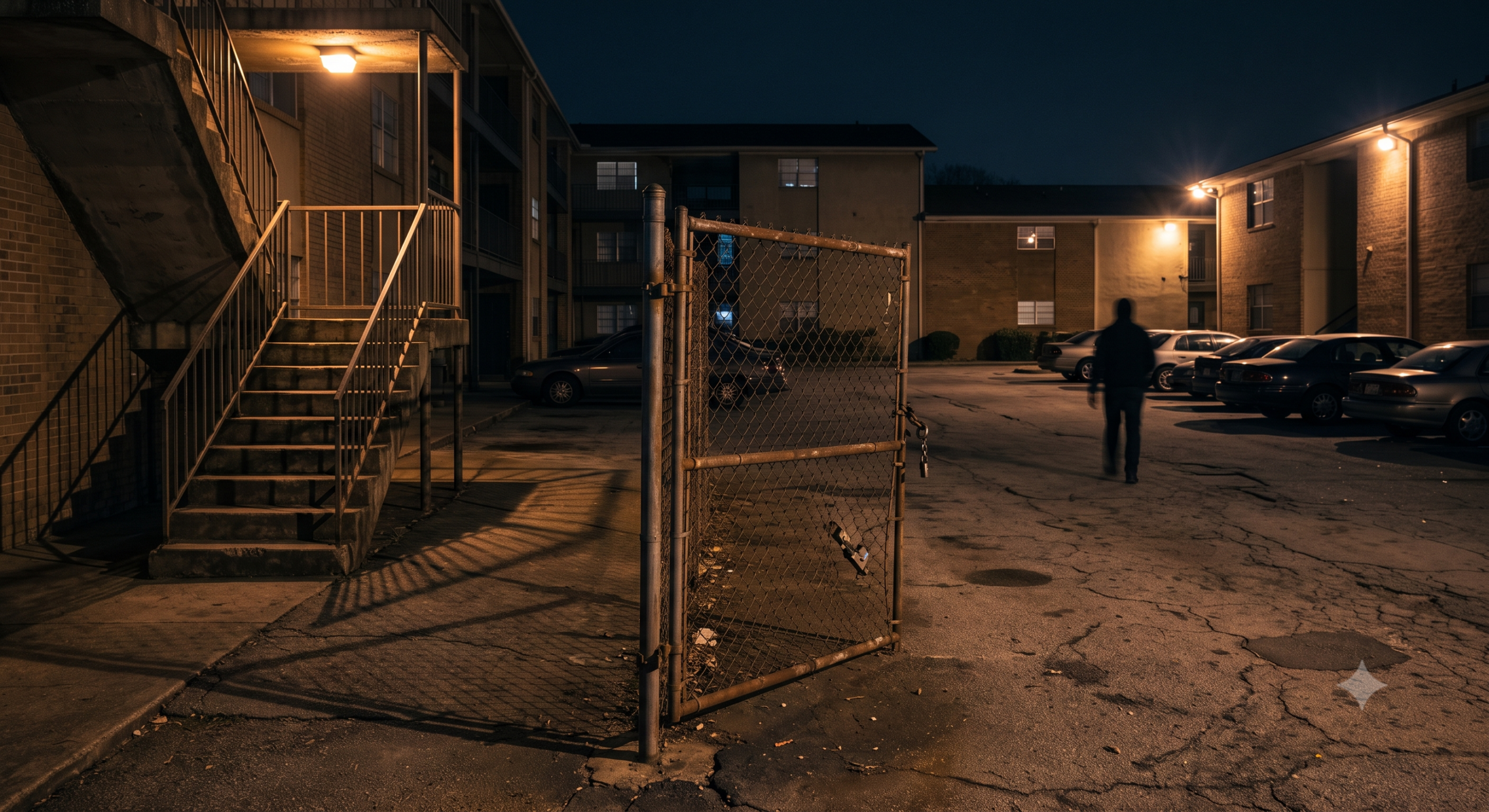
Negligent security Atlanta residents face is a serious legal issue and one that landlords can be held accountable for. If you were attacked in a poorly lit parking lot, entered through a broken gate, or harmed on a property where management ignored repeated safety complaints, Georgia law may entitle you to compensation. Under O.C.G.A. § 51-3-1, property owners owe every lawful visitor a duty of ordinary care, and when they fail, victims can pursue a premises liability claim for medical bills, lost wages, and pain and suffering.
If this sounds familiar, the crime itself may not be the only injustice. Under Georgia law, the landlord or property manager who ignores those warning signs may be legally responsible. This is the foundation of a negligent security claim, a vital tool for Atlanta crime victims seeking to rebuild their lives.
Quick Answer: What is a Negligent Security Claim in Georgia?
In Georgia, negligent security is a form of premises liability that holds landlords and business owners accountable when inadequate measures, such as broken locks or poor lighting, allow a foreseeable crime to occur. Under O.C.G.A. § 51-3-1, owners owe a duty of “ordinary care” to those lawfully on their premises. If they fail this duty, an Atlanta premises liability attorney can help victims pursue compensation for medical bills, lost income, and trauma.
Key Takeaways
- Your landlord may owe you compensation. Under O.C.G.A. § 51-3-1, Georgia property owners are legally required to maintain reasonably safe conditions. When broken locks, failed lighting, or ignored complaints contribute to a crime, victims can pursue a negligent security claim for medical bills, lost wages, and pain and suffering.
- Foreseeability determines liability. If prior incidents, tenant complaints, or APD crime data show that the landlord had reason to anticipate danger, Georgia courts can hold the landlord responsible even if the actual attacker is never caught or sued.
- Time is your biggest enemy. You have two years to file under O.C.G.A. § 9-3-33, but surveillance footage disappears in 30 to 90 days, and evidence vanishes fast. The sooner you contact an attorney, the stronger your case.
The Concept of Foreseeable Criminal Activity
The central question in any negligent security case is: Did the landlord have a reason to know something like this could happen? Courts call this foreseeability.
Georgia law does not require owners to prevent every possible crime, but it does require a reasonable response to existing warning signs. A landlord who ignores police reports of repeated assaults, tenant complaints about broken gates, or documented gang activity may be liable for creating a situation where criminal harm was foreseeable.
Georgia Courts May Find a Crime “Foreseeable” When:
- Similar crimes have recently occurred on the property or in adjacent areas.
- The property is in a neighborhood with high crime rates, according to APD data.
- Tenants submitted written complaints about safety hazards before the incident.
- An ongoing dispute or threatening behavior was visible to management.
- The property had a prior history of robberies, assaults, or trespassing.
“When a property is located in an area known for a high rate of crime, certain criminal actions might be considered foreseeable, and the property owner is expected to take security measures to prevent such crimes.”
Georgia Premises Liability Doctrine O.C.G.A. § 51-3-1
Analyzing Local Crime Statistics and APD Data
Early in an investigation, a premises liability attorney may pull granular data. The Atlanta Police Department’s Open Data Portal provides neighborhood-level records used to build a foreseeability argument.
|
Statistic |
Value |
Source |
|
Crimes per 1,000 residents |
43 |
NeighborhoodScout / FBI |
|
Chance of property crime |
1 in 27 |
NeighborhoodScout Analysis |
| Statute of Limitations |
2 Years |
O.C.G.A. § 9-3-33 |
If APD records show documented incidents in Vine City, Old Fourth Ward, or Mechanicsville months before an attack, that history proves the danger was real and knowable. Research by 33°n shows that while violent crime has declined broadly in Atlanta, specific corridors with deferred maintenance remain high-risk zones.
What This Means for Tenants:
Your attorney can formally request APD reports for a specific address. This evidence, combined with maintenance logs and surveillance footage, forms the backbone of a landlord liability-for-crime case. Because footage is often overwritten within 30 to 90 days, speed is critical.
Examples of Negligent Security: Lighting and Locks
Most Atlanta cases involve preventable failures rather than a lack of high-tech systems. Common failures include:
- Broken Lighting: Burned-out bulbs in stairwells or parking lots create opportunities for assault.
- Malfunctioning Locks: A front gate that doesn’t latch or a lobby door with a broken keypad allows unauthorized access.
- Non-functional Cameras: Broken cameras signal to criminals that management is not serious about security.
- Absent Personnel: High-risk areas, such as nightclubs or parking garages, may require security patrols.
- Ignored Complaints: A paper trail of maintenance requests is powerful evidence of a landlord’s breach of duty.
Under O.C.G.A. § 51-3-1, owners must exercise “ordinary care” to keep approaches safe. This liability is distinct from the criminal case against the attacker; while the criminal case focuses on punishment, your civil claim focuses on your recovery.
What Victims Can Recover in a Lawsuit
A lawsuit ensures the financial weight of negligence doesn’t crush your family. Recoverable damages include:
- Medical Expenses: ER costs, surgeries, and mental health counseling.
- Lost Wages: Compensation for time away from work or diminished earning capacity.
- Pain and Suffering: Recognition of the psychological aftermath, including PTSD and anxiety.
- Wrongful Death: If a crime takes a life, surviving family members can bring a claim.
Under Georgia’s modified comparative negligence rule (O.C.G.A. § 51-12-33), you can recover damages as long as your share of fault is below 50%.
The Georgia Statute of Limitations
You generally have two years from the date of injury to file a lawsuit (O.C.G.A. § 9-3-33). However, evidence disappears much faster. Witnesses forget details, and landlords may repair the very conditions, like a broken lock, that caused the injury. If the property is government-owned, “ante litem” notice deadlines can be as short as six months.
The Practical Takeaway:
Do not wait. The earlier a legal team begins preserving evidence, the stronger your landlord’s liability for crime in a GA case becomes.
Seeking Justice with a Property Liability Attorney
Proving a negligent security claim requires demonstrating a duty, a breach of that duty, and a direct link to the harm suffered. At The Roth Firm, we approach these cases as a form of community advocacy.
Our Process Includes:
- Evidence Preservation: Immediately securing surveillance and maintenance logs.
- Expert Analysis: Partnering with security experts to establish the professional standard of care.
- Data Research: Using APD data to link landlord inaction to known risks.
- Damages Accounting: Quantifying long-term psychological and financial impacts.
- Litigation: Aggressively negotiating with insurers or presenting to a jury.
We operate on a contingency-fee basis, meaning access to an Atlanta personal injury legal team is available regardless of your current financial situation. If you were harmed on property that was poorly secured, reach out to The Roth Firm for a free consultation.
Disclaimer: This content is for informational purposes only and does not constitute legal advice, nor an attorney-client relationship. Prior results do not guarantee a similar outcome.